
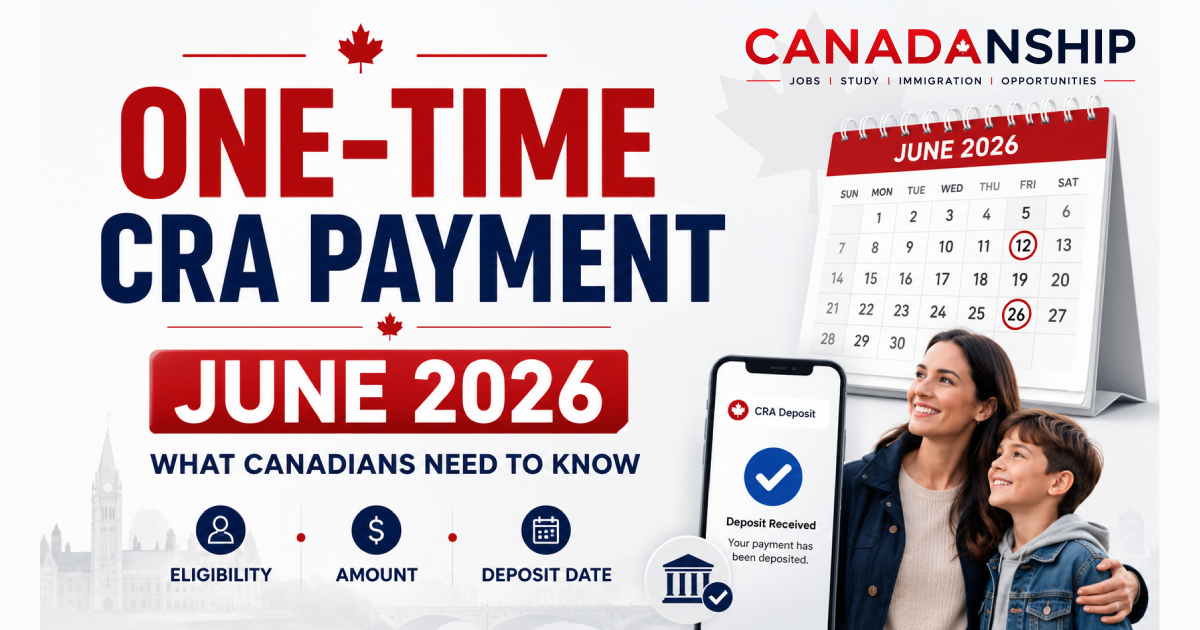
What Is The New One-Time CRA Payment Coming In June 2026?
The June 2026 payment is a one-time GST/HST credit top-up issued by the Canada Revenue Agency. It is designed to provide temporary financial relief before the launch of the Canada Groceries and Essentials Benefit later in the summer.
This top-up payment equals 50% of the total annual GST/HST credit amount that an eligible individual or family was entitled to receive during the July 2025 to June 2026 benefit period.
The payment is not a new monthly benefit program. It is a one-time additional amount connected to existing GST/HST credit eligibility rules.
The CRA will calculate the payment using information from 2024 tax returns and family details already on file. Canadians do not need to apply separately or complete any additional registration process.
Quick Overview Of The June 2026 Payment
| Payment Detail | Information |
|---|---|
| Program Type | One-time GST/HST credit top-up |
| Expected Start Date | June 5, 2026 |
| Application Needed | No separate application required |
| Issued By | Canada Revenue Agency |
| Payment Method | Direct deposit or mailed cheque |
| Eligibility Based On | 2024 tax return and family information |
Why The Federal Government Introduced This Payment
The federal government introduced this temporary support because many Canadians continue to struggle with the cost of basic living expenses. Food prices remain high in several provinces, while housing and utility costs have also increased significantly over recent years.
The government plans to replace the GST/HST credit system with the Canada Groceries and Essentials Benefit in July 2026. Before the official transition happens, the one-time top-up is being used to provide immediate short-term financial support.
Officials have stated that the updated benefit system will continue supporting low and modest-income Canadians through quarterly payments with increased amounts.
Who Is Expected To Receive The June 2026 Payment?
Canadians who qualified for the January 2026 GST/HST credit payment are generally expected to qualify automatically for the June top-up payment.
The CRA will review tax information and household details already available in its system to determine eligibility.
Eligible recipients may include:
- Single low-income Canadians
- Married or common-law couples
- Families with dependent children
- Seniors with qualifying income levels
- New permanent residents who filed taxes
- Some temporary residents meeting residency rules
The cra one-time payment eligibility rules are mostly connected to GST/HST credit qualification requirements.
When Will Canadians Receive The Payment?
The CRA is expected to issue payments beginning June 5, 2026. Canadians registered for direct deposit may see the money appear in their bank accounts on the same day or within a few business days.
People receiving payments through mailed cheques may experience additional delays depending on postal delivery times and regional mail service schedules.
Many Canadians searching for cra june payments information should also understand that some banks process federal deposits at different times during the day.
If the payment does not appear immediately on June 5, recipients are usually advised to wait several business days before contacting the CRA.
How Much Canadians Could Receive In June
The payment amount depends on annual GST/HST credit entitlement. Canadians with lower household income and larger family sizes may receive higher payments.
The CRA uses adjusted family net income from 2024 tax returns when calculating payment amounts.
Below are estimated maximum payment amounts for different household situations.
Estimated Maximum One-Time Payment Amounts
| Family Situation | Estimated Maximum Amount |
|---|---|
| Single individual | Up to $267 |
| Couple without children | Up to $349 |
| Family with 1 child | Up to $441 |
| Family with 2 children | Up to $533 |
| Family with 3 children | Up to $625 |
| Family with 4 children | Up to $717 |
These amounts are estimated maximums. Actual payments may be lower depending on income level and household details.
Example Of How Payment Calculations Work
If a single Canadian qualified for an annual GST/HST credit amount of $400 during the July 2025 to June 2026 benefit year, the one-time top-up would equal 50% of that amount.
In this example, the payment would be approximately $200.
Families with more dependents and lower income levels may qualify for higher annual credit amounts, which can increase the value of the June top-up.
Why Some Canadians May Not Receive It
Not every Canadian will qualify for the payment. Several situations could prevent the money from being issued or deposited successfully.
The most common reason is that the person did not qualify for the January 2026 GST/HST credit.
Other individuals may experience payment reductions because the CRA applies the money toward outstanding balances or debts.
Common Reasons A Payment May Not Arrive
| Reason | Explanation |
|---|---|
| No GST/HST credit eligibility | Not entitled to the top-up payment |
| Unfiled tax return | CRA cannot calculate benefit amount |
| Outstanding CRA balance | Payment may be offset against debt |
| Incorrect banking information | Deposit may fail or be delayed |
| Family payment issued to spouse | Household payment already processed |
Why Your Payment May Be Lower Than Expected
Some Canadians may receive smaller amounts than anticipated even if they qualify for the payment.
This often happens because of changes in income, marital status, dependent information, or shared child custody arrangements.
If your household income increased in 2024 compared to previous years, your GST/HST credit entitlement may have been reduced. Since the one-time payment is based on that credit amount, the top-up may also be lower.
Parents with shared custody arrangements may receive only partial child-related amounts compared to full custody households.
Provincial and territorial credits are also not included in the one-time federal top-up.
What Happens If You Owe Money To The CRA?
Canadians with outstanding balances may not receive the full payment amount.
The CRA has authority to apply federal benefit payments toward unpaid debts connected to canada revenue agency taxes, benefit overpayments, penalties, or other government obligations.
In some situations, the entire payment may be used to reduce an existing balance before any money reaches the recipient.
Canadians can review their account balances and debt information through CRA My Account online.
How The Payment May Appear In Bank Accounts
Some banks may still display the payment using GST/HST credit descriptions even though the system is transitioning toward the Canada Groceries and Essentials Benefit.
Financial institutions across Canada may update payment descriptions at different times.
People checking for the canada revenue agency june 2026 deposit should monitor their bank accounts carefully around the payment period.
Direct Deposit Versus Paper Cheques
Direct deposit remains the fastest and safest way to receive federal benefit payments.
Canadians who have direct deposit enabled through the CRA usually receive payments earlier than individuals waiting for paper cheques.
Paper cheques may require additional mailing time depending on location and postal service conditions.
Canadians who recently changed banks or addresses should verify their information before June 2026 to avoid delays.
How This Connects To The Canada Groceries And Essentials Benefit
The June payment acts as a bridge between the existing GST/HST credit system and the new Canada Groceries and Essentials Benefit launching in July 2026.
The updated program is expected to continue quarterly payments while increasing support for low and modest-income Canadians.
The federal government has stated that the new benefit will include a 25% increase to quarterly support amounts over several years.
Existing GST/HST credit recipients are expected to transition automatically into the updated system without submitting a separate application.
What Further Changes In July 2026?
The Canada Groceries and Essentials Benefit officially begins in July 2026.
The first quarterly payment under the updated system is expected around July 3, 2026.
Unlike the June top-up, future quarterly payments will use 2025 tax return information for calculations.
This means Canadians with lower income in 2025 could potentially qualify for larger quarterly payments later in the year.
Additional increases to federal benefit programs may also begin during the same period.
Important Things Canadians Should Check Before June 2026
Before payment dates arrive, Canadians should review important CRA account information carefully.
- Verify direct deposit details
- Confirm mailing address accuracy
- File any missing tax returns
- Review GST/HST credit eligibility
- Check household and dependent information
- Monitor CRA balances and debt notices
Small account errors can sometimes delay federal benefit payments.
What This Means For Canadian Households
For many families and individuals, the June 2026 payment may provide temporary help with essential expenses such as groceries, fuel, rent, utilities, childcare, and transportation.
Although the payment is not designed to fully solve affordability challenges, it may reduce short-term financial pressure for lower-income households.
The broader transition toward the Canada Groceries and Essentials Benefit also suggests the federal government plans to continue focusing on affordability support programs in future years.
Canadians are encouraged to monitor official CRA updates and keep their tax and banking information current to avoid payment issues.
Frequently Asked Questions (FAQs)
1. What is the new one-time CRA payment for June 2026?
The June 2026 one-time payment is a temporary GST/HST credit top-up issued by the Canada Revenue Agency to help eligible Canadians manage rising living costs. The payment is part of the transition toward the new Canada Groceries and Essentials Benefit that officially begins in July 2026. Eligible recipients do not need to submit a separate application because the CRA automatically calculates eligibility using tax return information already on file.
2. Who qualifies for the June 2026 CRA payment?
Most Canadians who qualified for the January 2026 GST/HST credit payment are expected to qualify automatically for the one-time top-up. Eligibility is mainly based on household income, marital status, residency, and dependent information from your 2024 tax return. Low and modest-income individuals, couples, seniors, and families with children are among the groups most likely to qualify for the payment.
3. When will Canadians receive the one-time CRA payment?
The CRA is expected to begin issuing payments starting June 5, 2026. Canadians enrolled in direct deposit may receive the money faster, while paper cheques may take additional business days to arrive by mail. Processing times can also vary depending on the recipient’s bank and regional postal delivery schedules.
4. How much money could Canadians receive from the June 2026 payment?
The payment amount depends on your annual GST/HST credit entitlement for the July 2025 to June 2026 benefit year. Single individuals may receive up to approximately $267, while families with children could receive significantly larger amounts. The exact amount depends on your adjusted family net income and household size reported on your tax return.
5. Why might some Canadians receive a smaller payment than expected?
Several factors can reduce the final payment amount. Higher household income in 2024, changes in marital status, shared child custody arrangements, or updates to dependent information may all affect calculations. In addition, provincial and territorial benefit amounts are not included in the federal one-time top-up payment, which can cause confusion for some recipients expecting larger deposits.
6. What happens if someone owes money to the CRA?
If you have unpaid taxes, benefit overpayments, penalties, or other outstanding government balances, the CRA may apply part or all of the one-time payment toward those debts before issuing any remaining amount. Some Canadians may notice a reduced deposit or no deposit at all because the payment was automatically offset against existing balances.
7. Do Canadians need to apply separately for the one-time payment?
No separate application is required for eligible Canadians. The CRA automatically reviews tax records and GST/HST credit eligibility information already available in its system. Canadians only need to ensure that their recent tax returns have been filed and their personal information is accurate to avoid delays or eligibility issues.
8. Will the June 2026 payment affect future quarterly benefit payments?
No. The one-time June payment is separate from future quarterly payments under the Canada Groceries and Essentials Benefit. Starting in July 2026, the new benefit system will use 2025 tax return information to calculate future payments. Receiving the June top-up should not reduce or replace future quarterly benefit amounts.
9. How can Canadians check the status of their CRA payment?
Canadians can monitor payment details through CRA My Account online. The account allows users to review benefit eligibility, payment dates, direct deposit information, tax return status, and outstanding balances. Checking your CRA account before June 2026 may help prevent delays caused by incorrect banking or mailing information.
10. What should Canadians do if they do not receive the payment?
If the payment does not arrive on the expected date, Canadians are usually advised to wait several business days before contacting the CRA because bank processing and mail delivery times can vary. Recipients should also verify their direct deposit details, tax filing status, and account balances through CRA My Account. In some situations, the payment may have been delayed, mailed by cheque, or applied toward an outstanding CRA balance.