
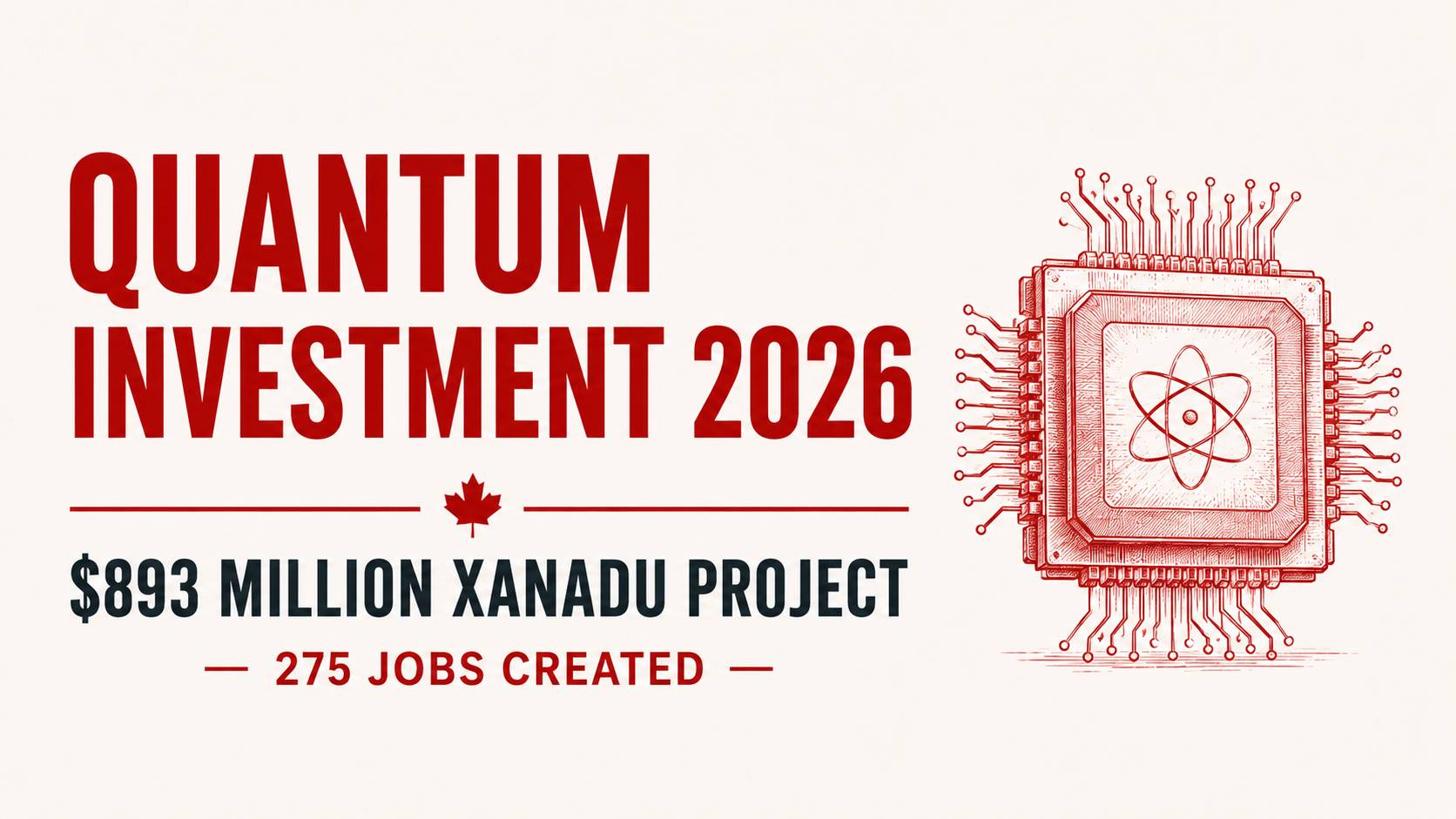
Canada is backing a major expansion of domestic quantum manufacturing with a $195 million federal investment in Xanadu Quantum Technologies. The funding supports a $893 million project to expand research and development and establish specialized manufacturing capabilities in Canada.
Innovation, Science and Economic Development Canada announced the investment in Toronto on August 28, 2026. The government says the project is expected to create 275 high-quality jobs while building facilities needed to develop, manufacture and commercialize quantum technologies.
The Numbers Behind Project OPTIMISM
- Federal contribution: $195 million through the Strategic Response Fund
- Total project: $893 million
- Projected jobs: 275
- Main focus: R&D expansion plus advanced quantum manufacturing
- Location: Canada, with the announcement made in Toronto
This Is a Manufacturing Story, Not Only a Research Story
Quantum computing is often discussed as laboratory research, but Xanadu’s project focuses heavily on the physical systems needed to build and scale quantum computers. The federal release says the project will develop capabilities for integrating, packaging, testing and assembling advanced photonic and semiconductor components.
Those manufacturing steps matter because a useful quantum computer requires more than algorithms. Components have to be produced, tested and assembled with extremely tight technical tolerances.
What Types of Jobs Could the Expansion Support?
The federal announcement does not publish a list of 275 currently open vacancies. The 275 figure is a project-level employment projection, not a live hiring count.
Based on the work described by the government, hiring associated with an advanced quantum manufacturing facility could span areas such as:
- photonics engineering;
- semiconductor process engineering;
- hardware integration and test;
- manufacturing engineering;
- quantum systems research;
- software and control systems;
- quality and reliability engineering;
- technical operations;
- research partnerships; and
- specialized project and supply-chain management.
Applicants should verify actual roles through Xanadu’s career site as the project develops. Canadanship’s Jobs section can also be used to follow current Canadian technology openings.
Why Photonic Quantum Computing Is Different
Xanadu is known for a photonic approach to quantum computing, which uses light-based components as part of the system architecture. The new project aims to build industrial-scale capabilities that the federal government says do not currently exist for future fault-tolerant quantum computing.
That wording is important: Canada is investing not just in one computer, but in manufacturing processes that could support a larger domestic quantum supply chain.
Partnerships With Research Institutions and SMEs Are Part of the Plan
The federal release says the expansion will support partnerships with Canadian research institutions and small and medium-sized businesses. That can broaden the effect beyond Xanadu itself.
A domestic quantum manufacturing ecosystem may need specialized suppliers, electronics firms, optical-component companies, software providers, test-equipment expertise and academic research partners.
Those secondary opportunities are potential ecosystem effects, not jobs guaranteed by the August 28 announcement.
How This Fits Canada’s National Quantum Strategy
The investment advances Canada’s National Quantum Strategy as well as the country’s new Defence Industrial Strategy. Quantum technologies can have applications in cybersecurity, defence, health care, energy and logistics.
From a policy perspective, the project is about keeping more of the technology-development chain in Canada: research, component development, manufacturing and commercialization.
The Quantum Sector Has Large Long-Term Projections
The government cites a projection that Canada’s quantum sector could contribute $17.7 billion to GDP and more than 157,000 jobs by 2045.
Those numbers should not be confused with today’s labour market. They are long-range sector projections. The only direct project employment figure in the August 28 Xanadu announcement is 275 jobs.
What Skills Are Likely to Matter?
Quantum companies often recruit from several technical disciplines rather than only from physics. Depending on the role, useful backgrounds can include electrical engineering, photonics, computer engineering, software, materials science, semiconductor manufacturing, mechanical engineering and applied mathematics.
Manufacturing roles can also require experience with process control, test systems, cleanroom environments, yield improvement, reliability and quality assurance.
What Students Can Do With This Information
Students should treat the announcement as a signal about an expanding technology cluster, not as proof that any specific degree guarantees a job.
A strong preparation strategy could include:
- building a solid foundation in a relevant engineering, computing or physical-science discipline;
- seeking laboratory or hardware experience;
- pursuing internships or co-op placements;
- learning how research moves into manufacturing; and
- following real employer job descriptions to understand current skill demand.
Students can explore Canadian study options through Canadanship’s Study section and practical placements through Internships.
International Talent Still Needs Work Authorization
The investment does not create a special quantum work permit. Foreign nationals hired into Canadian roles still need the right to work in Canada under the immigration rules that apply to them.
Highly specialized employers may recruit internationally, but each position and applicant must be assessed separately. Canadanship’s Work section covers broader work authorization updates.
Why Canada Is Funding Advanced Manufacturing
The Strategic Response Fund supports large projects intended to strengthen economic resilience, supply chains and Canadian industrial capacity. Quantum technology fits that strategy because the ability to manufacture advanced components domestically can affect both commercial competitiveness and national security.
Xanadu had already been selected as one of four Canadian companies eligible for up to $23 million through the first phase of the Canadian Quantum Champions Program announced in December 2025. The new $195 million commitment is a separate, much larger project-level investment.
The Federal Contribution Covers Part of the Total Project
The announced $195 million federal contribution represents about 21.8% of Xanadu’s $893 million project value. The remaining project financing is not described in the news release as an additional federal grant.
This distinction matters when reading large investment headlines: the $893 million figure is the total project value, while $195 million is the announced federal contribution through the Strategic Response Fund. The employment figure of 275 is attached to the overall project described by the government.
The news release also does not provide a month-by-month hiring schedule. Readers should therefore treat the employment number as a project outcome and use actual Xanadu postings to determine which jobs are currently accepting applications.
What to Watch Next
The next useful developments will be concrete: facility expansion, manufacturing milestones, supplier agreements, research partnerships and actual job postings. A project of this scale can recruit in stages as R&D, manufacturing setup, testing and production capacity develop.
Those milestones will provide a better picture of when the government’s projected 275-job impact turns into active recruitment.
Potential Impact on Canada’s Quantum Supply Chain
Advanced photonic and semiconductor systems depend on specialized materials, fabrication, packaging, testing and precision equipment. Building more of those capabilities domestically can reduce dependence on external suppliers and create opportunities for Canadian SMEs with relevant expertise.
That supply-chain effect is one reason the federal government links the project with economic resilience and sovereignty, not only with research leadership.
Official Reading
| Link | What it confirms |
|---|---|
| ISED – Government investment in Xanadu | $195 million federal investment, $893 million project, 275 projected jobs, manufacturing scope and long-term quantum-sector projections. |
| Government of Canada – National Quantum Strategy | Broader Canadian quantum policy, commercialization and research context. |
Verified August 30, 2026. The 275 figure refers to jobs the project is expected to create, not a current vacancy total.