
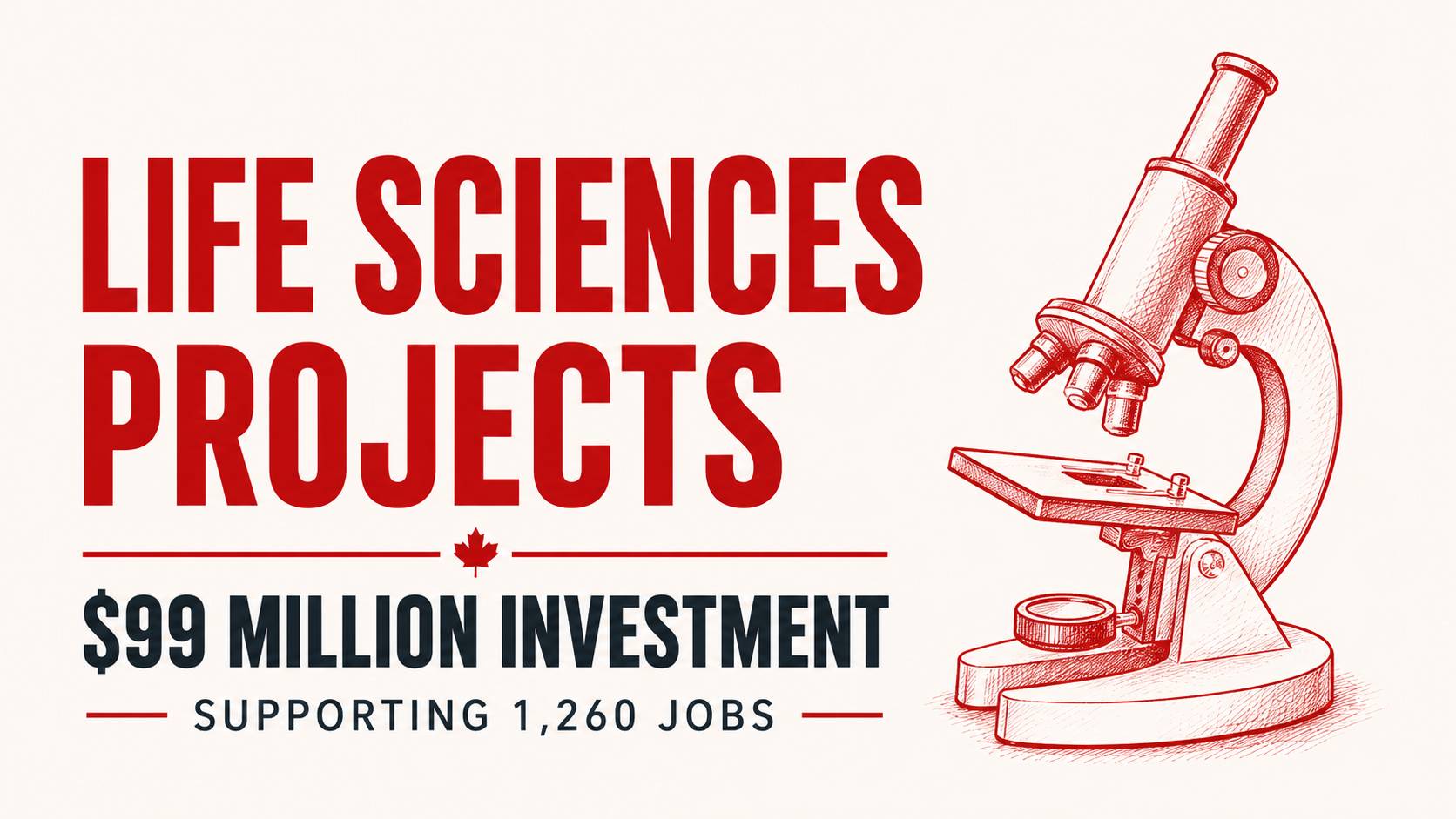
Canada is investing nearly $100 million in two British Columbia life sciences projects that are expected to expand medical-device and biomanufacturing capacity while creating or maintaining about 1,260 skilled jobs. The August 27, 2026 announcement includes up to $31.25 million for Kardium Inc. and up to $68 million for Evonik Canada Inc.
The funding comes through the federal Strategic Response Fund. Kardium’s project focuses on manufacturing an advanced medical device for atrial fibrillation, while Evonik is expanding capacity for lipid-based technologies used in mRNA vaccines and therapies.
Investment and Job Details
| Company | Project value | Federal contribution | Jobs created or maintained |
|---|---|---|---|
| Kardium Inc. | $125 million | Up to $31.25 million | 1,000 |
| Evonik Canada Inc. | More than $150 million | Up to $68 million | 260 |
| Combined | More than $275 million | More than $99 million | About 1,260 |
Kardium is expanding medical-device manufacturing in Burnaby
Kardium is a privately held medical technology company founded in 2007 and headquartered in Burnaby, British Columbia. The federal investment supports a $125 million project to build manufacturing capacity for the company’s Globe Pulsed Field System.
The device is used in the treatment of atrial fibrillation, a common form of cardiac arrhythmia. The system combines mapping and ablation functions and received Health Canada regulatory approval in July 2026. The U.S. Food and Drug Administration approved the device in September 2025.
Production capacity is planned to rise from 500 to 30,000 units
The scale of Kardium’s manufacturing plan is significant. According to the federal announcement, the project will expand cleanroom capacity from about 500 units a year to 30,000.
That expansion is intended to help the company meet growing market demand while keeping intellectual property and advanced manufacturing activity in Canada.
The government says the project will create and maintain a total of 1,000 highly skilled jobs in British Columbia.
What kinds of roles could a medical-device expansion support?
The federal announcement does not publish a list of 1,000 current vacancies, so it would be inaccurate to describe the project as “1,000 jobs open now.”
Large medical-device manufacturing operations can involve work across areas such as:
- manufacturing and production engineering;
- quality assurance and quality control;
- regulatory affairs;
- cleanroom production;
- equipment maintenance and automation;
- software and systems engineering;
- medical device research and development;
- supply chain and procurement;
- clinical and technical support; and
- operations and management.
The actual positions, qualifications and hiring dates must be confirmed through Kardium’s career pages and other official employer postings.
Evonik is building a Nucleic Acid Competence Centre
The second investment provides up to $68 million toward Evonik’s project of more than $150 million in British Columbia. The project includes building and operating a Nucleic Acid Competence Centre.
Evonik is headquartered in Burlington, Ontario, while its British Columbia life sciences operations began in the Burnaby area in 2016. The company works in technologies connected with mRNA and lipid nanoparticle drug products.
The Evonik project will support next-generation mRNA manufacturing
The new facility is intended to expand product development and manufacturing capacity for next-generation mRNA vaccines and therapies. Lipid nanoparticles are important because they can be used to deliver nucleic-acid-based medicines into the body.
The federal government says the expansion will help move products from concept toward the clinic and strengthen Canada’s capacity in an area that became especially visible during the development of mRNA vaccines.
Evonik’s expansion is tied to 260 jobs
The announcement says Evonik’s project will create and maintain 260 jobs. As with the Kardium figure, “create and maintain” is broader than a live vacancy count.
Some roles may already exist and be retained because of the investment, while others may be created as new facilities and manufacturing capacity come online.
Why British Columbia is building a life sciences cluster
British Columbia has a long history in lipid-based drug delivery and a growing concentration of biotechnology, medical technology and research organizations. The provincial government says its Look West strategy includes a 10-year goal to double the number of B.C. life sciences jobs to 40,000 and increase the sector’s economic impact by 75%.
The Kardium and Evonik projects fit that wider strategy by adding both medical-device production and biopharmaceutical manufacturing capacity.
Canada has invested more than $2.5 billion since 2020
The federal government says it has invested more than $2.5 billion in 43 biomanufacturing, vaccine and therapeutics projects since 2020.
The purpose has been to expand domestic research, manufacturing and pandemic-response capacity while strengthening Canadian supply chains for medicines and health technologies.
How this differs from the August 25 workforce-training announcement
Canada also announced up to $8.7 million for CASTL life sciences and biomanufacturing training earlier in the same week. These are separate initiatives.
The CASTL funding focuses on workforce training and skills development. The August 27 Kardium and Evonik funding supports company expansion, manufacturing facilities and industrial capacity.
For job seekers, the two announcements are connected in a practical sense: industrial expansion can increase employer demand, while workforce training is intended to help people gain skills for sectors facing shortages. They should not, however, be presented as one combined program.
What students should watch
Students interested in biotechnology, biomedical engineering, chemical engineering, pharmaceutical sciences, manufacturing, regulatory affairs or related disciplines may want to follow these companies as they expand.
Co-op and internship opportunities can provide a route into highly regulated industries because employers often value practical experience with quality systems, laboratory work and manufacturing standards.
Students can follow Canadanship’s Internships and Study sections for relevant opportunities and education updates.
What newcomers and international workers should understand
A company expansion does not create a special work permit. Foreign nationals still need to be authorized to work in Canada unless an exemption applies.
An employer may recruit internationally for some specialized roles, but the federal funding announcement itself does not say that Kardium or Evonik will sponsor foreign workers for all future vacancies.
Work permit and employment authorization information should be checked separately through Canadanship’s Work section and IRCC.
Why regulated life sciences jobs can have specific requirements
Medical devices and pharmaceutical manufacturing operate in regulated environments. Employers may require experience with quality management systems, good manufacturing practices, validation, documentation, regulatory submissions or technical standards depending on the role.
That means candidates should read job descriptions closely rather than assuming a general science degree automatically matches every position.
Where job seekers should look
Current openings should be confirmed through the employer’s own career pages and reputable job platforms. Canadanship’s Jobs section can also be used to track new employer postings as the projects progress.
Job seekers should search by skill as well as company name. An expanding life sciences facility may recruit engineers, technologists, quality specialists, supply-chain staff, software professionals and operations workers at different stages.
What the announcement does not mean
- There are not necessarily 1,260 vacancies open today.
- The federal government is not directly hiring all 1,260 workers.
- The investment does not create a new immigration pathway.
- Job requirements will vary substantially between Kardium, Evonik and individual occupations.
- Project funding does not guarantee that every projected job will be created at the same time.
Why the projects matter beyond hiring
The projects are also about industrial capacity. Kardium plans to increase production of a Canadian-developed medical technology dramatically, while Evonik intends to expand Canada’s ability to develop and manufacture lipid-based therapies.
Keeping intellectual property, production expertise and specialized manufacturing capacity in Canada can influence research partnerships, exports, supplier networks and future investment in addition to direct employment.
How job seekers can prepare for expansion hiring
People who want to position themselves for future hiring should start by comparing their current skills with the types of work found in regulated manufacturing environments. For example, a quality specialist may need experience with documented quality systems and corrective actions, while a manufacturing engineer may need process-validation, equipment or production-scale experience.
Job seekers can strengthen their position by identifying the language employers use in current postings and then building evidence around those requirements. That can mean gaining experience with regulated documentation, cleanroom procedures, automation, data analysis, quality standards or cross-functional project work depending on the occupation.
Applicants should also avoid describing unrelated experience too broadly. In specialized sectors, employers often want proof that a candidate understands the environment in which the work will be performed. A detailed example of solving a production, quality or technical problem can be more useful than a generic statement that someone has “strong problem-solving skills.”
Why manufacturing scale can change the local labour market
Kardium’s planned increase from 500 to 30,000 units annually is not simply a larger production target. Scaling a regulated medical device from a relatively small output to tens of thousands of units can require more structured production systems, quality oversight, supplier management, equipment support and operations planning.
Similarly, an expanded nucleic-acid manufacturing centre can increase demand for specialized scientific and technical functions that may not exist at the same scale in a smaller facility. This is why industrial investment can create opportunities across several occupational groups rather than only for scientists.
Related suppliers may also benefit
Large life sciences projects can affect companies beyond the two direct recipients of federal funding. Manufacturing facilities purchase equipment, laboratory supplies, software, engineering services, logistics support and specialized professional services. Over time, that can create indirect demand across the wider British Columbia life sciences ecosystem.
Those indirect effects are not included in the government’s 1,260 jobs created-or-maintained figure, so they should not be presented as guaranteed additional employment. They are better understood as a potential secondary economic effect of larger local production capacity.
Official Sources and What They Confirm
| Official source | Details confirmed by the source |
|---|---|
| Innovation, Science and Economic Development Canada – August 27 life sciences investment | Federal contributions, Kardium and Evonik project values, manufacturing expansion, regulatory status, 1,000 and 260 job figures, and wider sector context. |
| Government of Canada – Strategic Response Fund / strategic investment information | Federal industrial-investment context for large projects designed to strengthen Canadian economic capacity and jobs. |
Last verified August 28, 2026. Job figures in the government release refer to positions created and maintained by the projects, not a count of vacancies currently accepting applications.